
Playground Safety Surfacing Standards: EN 1177 vs ASTM F1292 Thickness Guide for Project Bids
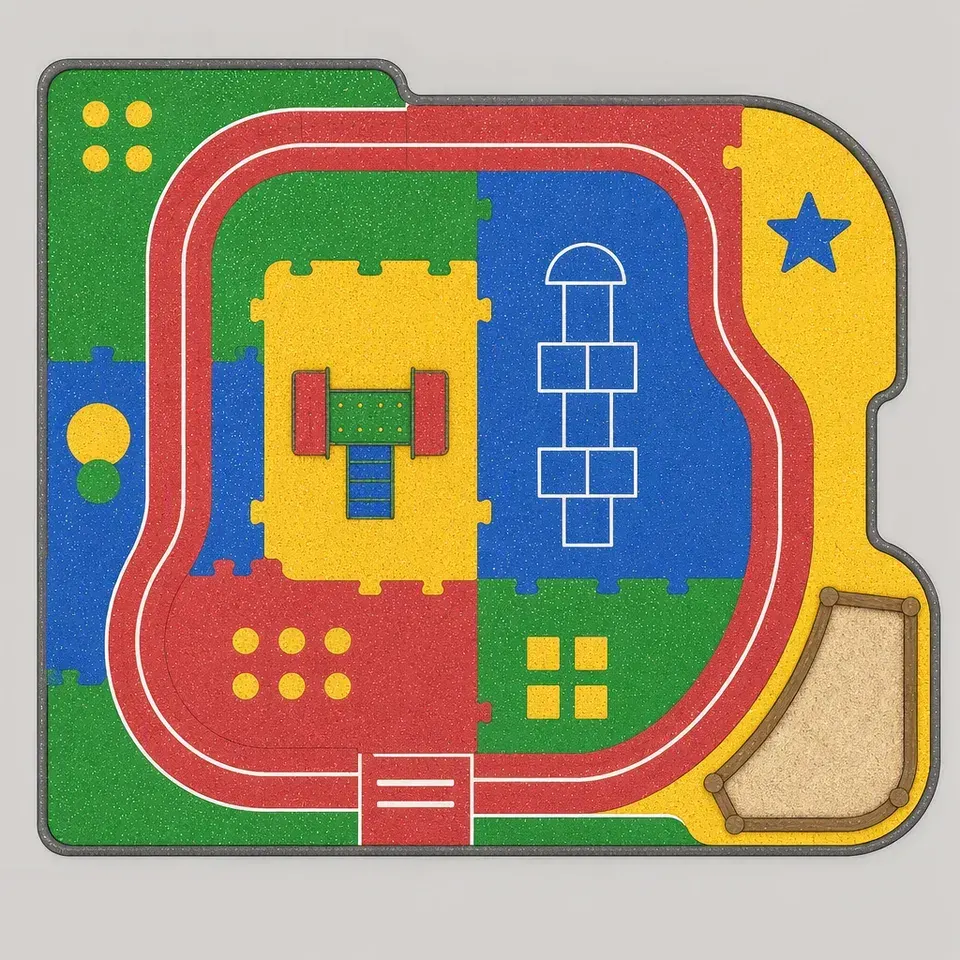
Playground safety surfacing is one of the few flooring categories where a specification error can cause an injury — and a rejected technical bid. This guide explains the two global standards, how critical fall height maps to rubber tile thickness, and what test data actually belongs in a project submittal. It is written from the factory side: our granular rubber tiles are tested to GB 36246-2018 (report GT250048), and the numbers below come from that report.
EN 1177 or ASTM F1292: which one governs your project
Two standards dominate playground impact-absorbing surfacing worldwide:
• **EN 1177 (Europe and most of the world):** measures the Critical Fall Height (CFH) of the surface using a Head Injury Criterion (HIC) headform test. Equipment manufacturers state the free-fall height of each play element; the surface must be certified to a CFH at or above that value.
• **ASTM F1292 (United States):** uses the same HIC methodology but reports G-max (peak deceleration) alongside HIC, and is referenced across North America and by US-influenced specs in the Gulf.
For Middle East and Southeast Asia project bids, the specification usually names EN 1177 with an HIC ≤ 1000 threshold, sometimes both standards. The practical difference for a buyer is minimal — both certify a surface by fall height, not by material name. What matters is that your chosen thickness is backed by test data for that exact build-up.
Critical fall height to thickness: the reference table
Industry practice under EN 1177 pairs tile thickness to certified fall height as follows (always confirm against the test report for the specific product build-up):
Reference pairing under EN 1177: 20-25 mm covers up to about 1.0 m fall height (toddler areas, low platforms); 30 mm covers about 1.5 m (standard play structures, slides); 40 mm covers about 1.9 m (higher platforms, swings); 50 mm covers 2.2 m and above (tall climbing structures, public playgrounds); 60-70 mm covers about 3.0 m (high rope courses, adventure parks).
A factory that molds tiles in a hot press can hold density uniform through the full thickness — which is what the certification depends on. Field-mixed wet-pour surfaces vary square meter by square meter, so their certified fall height is only as good as the installer's mixing discipline.
What our test data shows
Report GT250048 (Jiangsu Zhongzheng Testing, May 2025) covers our 50×50 cm granular rubber tiles to GB 36246-2018, the Chinese national standard for synthetic sports surfaces — one of the strictest school-surface standards in the world:
• **Shock absorption:** 37.5% at 0 °C, 40.6% at 23 °C, 44.3% at 50 °C (requirement: 25–50%). Note the direction: absorption improves as temperature rises — the opposite of plastics that soften and degrade in Gulf heat.
• **Vertical deformation 1.1 mm** (range 0.6–3.0) — stable underfoot, no trampoline effect.
• **Slip resistance 105 BPN dry** (range 80–110).
• **Hazardous substances:** phthalates 0.03 g/kg against a 1.0 limit; benzene, MOCA, TDI/HDI, short-chain chlorinated paraffins and soluble lead, cadmium, chromium and mercury all not detected. Formaldehyde emission 0.09 mg/m²h against a 0.4 limit.
• **Odor grade 3** (maximum allowed: 3).
For playground projects — where children contact the surface directly and municipalities answer to parents — the hazardous-substance page of a test report matters as much as the impact page.
Why factory-pressed tiles suit hot-climate playgrounds
In sustained 50–60 °C surface heat, binder quality decides whether a playground floor lasts two years or ten. Our tiles are hot-pressed from devulcanized recycled rubber granules with polyurethane binder: no field mixing, no weak layers, and shock absorption that holds or improves at temperature (the 50 °C result above is from the same report). Individual 500×500 mm tiles can also be lifted and replaced if a section is damaged — a maintenance argument every municipal owner understands. See our companion guide on hot-climate outdoor flooring for the full heat analysis: /blog/rubber-flooring-for-hot-climates/
Common technical-bid mistakes that cost points
1. **Quoting a material instead of a certified fall height.** "Rubber tiles, 30 mm" is incomplete; "30 mm tiles, certified CFH 1.5 m per EN 1177" is a submittal.
2. **Thickness mismatched to equipment.** The fall height is set by the tallest play element over each zone — swings and climbing frames often need 40–50 mm while toddler zones need 25–30 mm. Zone the floor accordingly.
3. **Test reports without the right page.** A generic material datasheet is not an impact test. Bid evaluators look for the HIC/CFH result, the thickness tested, and the issuing laboratory.
4. **Ignoring chemical safety.** School and municipal tenders increasingly require hazardous-substance results — lead and phthalate screens are now standard in EU and Gulf public procurement.
Specification checklist for playground surfacing
• Free fall height of the tallest equipment per zone (m)
• Required standard and threshold (EN 1177 HIC ≤ 1000 / ASTM F1292)
• Tile thickness per zone and total area
• Required test report pages: impact/CFH, hazardous substances, slip resistance
• Color and surface texture (pin-hole, checker, granular)
• Base condition (concrete, compacted stone, existing asphalt)
• Quantity, delivery port, and target installation window
Frequently asked questions
**What is critical fall height in playground flooring?**
The maximum free-fall height from which a surface is certified to protect a child, measured with an HIC headform test per EN 1177 or ASTM F1292. It is a property of the tested surface build-up — thickness, density and material — not of the rubber alone.
**Is 30 mm rubber tile enough for a playground?**
Only where the certified fall height covers your equipment. For play structures with platforms around 1.5 m, 30 mm tiles certified to CFH 1.5 m are typical. Taller elements — swings, climbing frames — require 40–50 mm. Always zone the floor by equipment fall height.
**EN 1177 or ASTM F1292 for a Gulf project?**
Most Gulf specifications follow EN 1177 (often with the HIC ≤ 1000 threshold), but US-influenced consultants may write ASTM F1292. Both certify fall height by the same headform principle; the practical requirement is a test report covering your exact product and thickness.
**Does rubber playground flooring get too hot in Middle East summers?**
Any dark surface heats in direct sun — light colors and shaded design help. Structurally, hot-pressed recycled rubber holds its shock absorption at 50 °C (our GT250048 result: 44.3%, up from 37.5% at 0 °C), which is why factory-pressed tiles outperform wet-pour in sustained heat.
The bottom line
Playground surfacing bids are won on certified numbers, not adjectives. Specify by critical fall height per EN 1177 or ASTM F1292, demand the impact and hazardous-substance pages of the test report for the exact thickness you are buying, and prefer factory-pressed tiles whose density — and certification — survives hot-climate service. Our 50×50 mm playground tiles (30–50 mm, 147 colors, MOQ 500 m², FOB Tianjin) are tested to GB 36246-2018 with reports available on request.
Questions About Your Project?
Our export team answers flooring questions daily — send your floor plan or specs and get a reply within 24 hours.