
Ballistic Rubber Tiles Buyer's Guide: How to Choose Range Backstop & Bullet Trap Panels
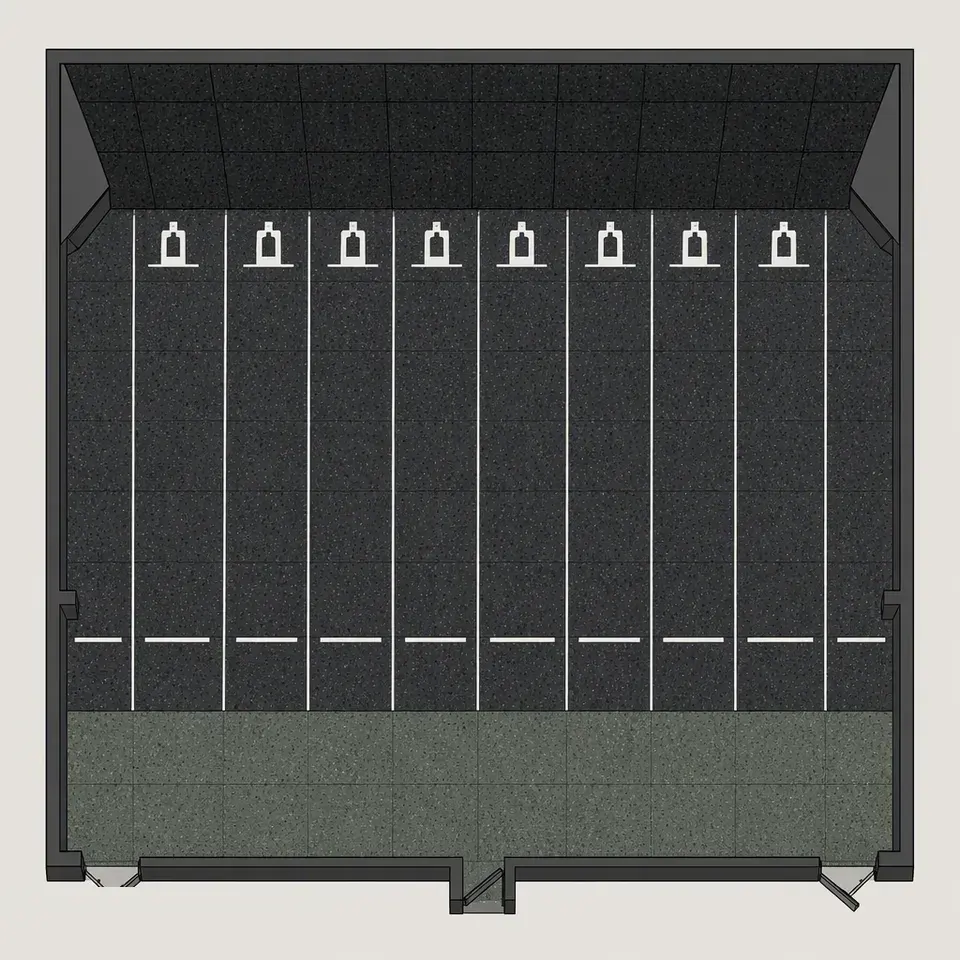
Ballistic rubber tiles are the workhorse surface behind every commercial and military shooting range: they line backstop walls, wrap bullet traps, shield firing-line partitions and protect floors in target-retrieval areas. This guide explains how these panels work, what specifications actually matter, and what to ask suppliers before you commit a container order.
What ballistic rubber tiles are
Ballistic rubber tiles are dense panels molded from recycled rubber granules (crumb rubber bound with polyurethane or latex). Typical formats are 500×500 mm, 600×600 mm and 1000×1000 mm panels, 15–50 mm thick, in black or colored granule finishes. On the wall they serve three jobs at once:
1. Energy absorption – the elastic granule body traps and deforms around the projectile, bleeding off velocity instead of returning it.
2. Spall and ricochet control – a properly formulated surface catches fragments and bullet jackets instead of throwing them back downrange.
3. Noise and lead-dust reduction – porous rubber deadens firing-line noise and, combined with good ventilation design, helps keep airborne lead particles out of the HVAC loop.
Thickness: match the panel to your calibre
Thickness is the first specification to settle, and it should be driven by your maximum calibre and typical engagement distance:
• Side walls, partitions, retrieval areas (indirect fire): 15–20 mm panels are usually sufficient. These zones see fragments and occasional direct hits at oblique angles.
• Direct-fire backstops (pistol and rimfire ranges): 25–30 mm panels are the common choice for walls behind target lines.
• Bullet-trap faces and high-volume rifle lanes: 40–50 mm panels, often doubled up with an air gap, or installed as the sacrificial layer in a total-encapsulation trap design.
A useful rule from range builders: specify the thickest panel your wall structure can carry in the trap and backstop zones, because replacing panels is far cheaper than repairing the substrate behind them.
Anti-spall vs. anti-ricochet: know the difference
Buyers often conflate these two properties:
• Anti-spall means the surface does not eject fragments of itself or the wall behind it when struck.
• Anti-ricochet (bullet trapping) means the surface accepts the projectile and prevents it from bouncing back toward the firing line.
Recycled-rubber ballistic tiles achieve both through density and elasticity rather than hardness. Ask suppliers for impact-test data on the specific panel density they quote — not just the material datasheet.
Mounting: bolts beat glue in high-throughput ranges
Two mounting methods dominate:
• Mechanical bolting – panels are drilled and bolted to a substrate or steel frame. Advantage: individual worn panels can be swapped in minutes without demolishing the wall. This is the standard for commercial ranges firing thousands of rounds a day.
• Adhesive bonding – panels are glued directly to flat concrete. Lower installed cost, but replacing a section means chiselling. Appropriate for low-throughput private and club ranges.
Lead-dust control and maintenance
Rubber panels are porous, which is good for noise but means unglazed surfaces will accumulate lead dust over time. Range hygiene practice:
• Vacuum (HEPA) rather than dry-sweep or blow panels.
• Plan a panel replacement cycle for trap faces — heavily used ranges budget for partial replacement every 1–3 years depending on throughput.
• Choose tiles with a two-layer construction (tough sacrificial face over a resilient core) to extend service life.
Test reports: what to ask for
Suppliers should provide, at minimum:
1. A general physical-performance test report covering density, tensile strength, compression set, abrasion and ageing. This confirms the panel is built from quality material.
2. Ballistic-impact or spall test data for the specific panel thickness and density you are ordering. Standards you may reference include NIJ 0108.01 (for ballistic-resistant materials generally) and range-industry guidance from bodies such as the National Rifle Association range manuals or NATO AC/225 documents for military facilities.
3. Fire-performance data for your local code — rubber is combustible, and many jurisdictions require a flame-spread rating for interior range finishes.
If a supplier offers ballistic-grade performance, ask whether the test reports can be issued against your project requirements (calibre, distance, wall build-up). Manufacturers with in-house labs can usually arrange project-specific testing; trading companies typically cannot.
Evaluating a ballistic rubber tile supplier
Use this checklist before ordering:
• Material origin: are panels molded from recycled tire granules in-house, or traded? In-house molding (heat-cured press) gives more consistent density.
• Density consistency: ask for density figures per batch, not a single brochure number. Ballistic performance lives and dies with density.
• Size and color flexibility: OEM thicknesses and granule colors from one production line let you color-code zones (e.g., red for trap faces, black for side walls).
• MOQ and mixed containers: serious factories accept 500 m² MOQs and mixed-SKU 20GP containers, so you can combine backstop, wall and floor panels in one shipment.
• Export track record: ask for references in your market — military, police academies and commercial range chains are the strongest signals.
Specification checklist to send manufacturers
• Panel size(s) and thickness(es) required
• Calibre classes and maximum engagement distance
• Wall substrate type (concrete, steel frame, blockwork)
• Preferred mounting: bolted or bonded
• Color/finish requirements and zone color-coding
• Required test reports (physical + ballistic-impact, fire)
• Target quantity, delivery port and timeline
The bottom line
Ballistic rubber tiles are a small line item in total range construction but they govern safety, noise and maintenance costs for the life of the facility. Specify thickness by calibre, insist on density data and impact tests for the exact panel you order, choose bolt-on mounting for commercial throughput, and treat supplier references in your region as seriously as the datasheet.
Questions About Your Project?
Our export team answers flooring questions daily — send your floor plan or specs and get a reply within 24 hours.